What Are Some Free Things To Do In Jackson Hole In Winter?
A honest list of genuinely free winter activities in Jackson Hole, from elk refuge pullouts to antler arches and Nordic trails, plus how a guided snowmobile tour from Jackson fits in.
What Are Some Free Things To Do In Jackson Hole In Winter?
Yes, Jackson Hole has a genuinely free winter lineup. The no-cost options are wildlife-viewing pullouts along the National Elk Refuge Road, the elk antler arches surrounding Jackson's Town Square, the National Elk Refuge and Greater Yellowstone Visitor Center, free Nordic ski and snowshoe trails at Cache Creek and Gray Meadow, and the Town Square holiday lighting celebration. None of these charge admission or a tour fee.
That list matters more than it sounds. Ski towns have a reputation for charging for every view, and Jackson Hole, home to three downhill resorts and some of the priciest lift tickets in North America, sits at the top of that reputation. Yet the town of Jackson itself, the valley floor around it, and the National Elk Refuge next door hold a set of winter experiences that cost nothing at the gate, because there is no gate. A visitor can fill two or three full days without buying a single activity.
The honest caveat is geographic. Everything free sits in and around the town of Jackson, in the southern half of the valley. The marquee winter sight in this region, Yellowstone's snow-bound interior with Old Faithful at its heart, is a different proposition. From mid-December to mid-March, most park roads are open to oversnow travel only, which means a commercially guided snowmobile tour or snowcoach, and private cars simply cannot drive to Old Faithful in winter. That is the one place a free itinerary runs out of road, and where a paid guided snowmobile tour, departing from the same Jackson hotels, picks up the thread. If you'd rather explore the park's western gateway instead, our guide to renting a snowmobile out of West Yellowstone explains why a guided tour usually wins out over going on your own.
For anyone building a mixed-budget trip, here is the free core in one view:
| Free activity | Where | What to know |
|---|---|---|
| National Elk Refuge Road pullouts | North edge of Jackson | Roadside viewing of the wintering elk herd; bring binoculars or a camera |
| Elk antler arches | Town Square, central Jackson | Corner arches built from shed antlers; free to walk any time |
| National Elk Refuge & Greater Yellowstone Visitor Center | Jackson area | Free exhibits and trip-planning help from staff |
| Cache Creek and Gray Meadow trails | Trailheads near Jackson | Free Nordic skiing and snowshoeing; check snow conditions before going |
| Town Square holiday lighting | Town Square, central Jackson | Seasonal lighting celebration in the heart of town |
The rest of this page walks through each one, then covers the practical question that follows: how these free days in Jackson connect, or do not connect, to Yellowstone itself.
Where Can You Watch Wildlife For Free Around Jackson?
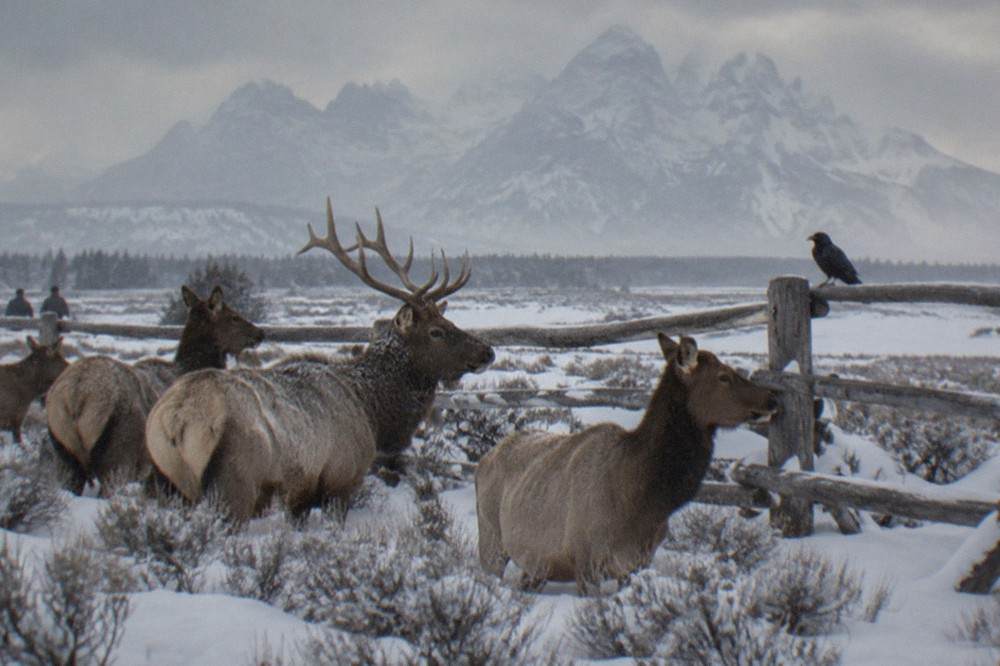
The free wildlife option is the National Elk Refuge Road, where roadside pullouts let visitors watch the wintering elk herd from a car or the shoulder, no permit, no fee, no guide. The National Elk Refuge and Greater Yellowstone Visitor Center nearby adds free exhibits and staff who can point to where animals have been seen recently. Together they form the closest thing Jackson Hole has to a no-cost safari.
The National Elk Refuge borders the town of Jackson to the north and east, and each winter thousands of elk descend from the high country onto its feedgrounds and open snowfields. The Refuge Road runs along the edge of this winter range, and the pullouts along it are the public's free window onto the herd. Winter is the season when this works: the animals are concentrated, visible against the snow, and often close enough to watch comfortably from a pullout without ever leaving the car. Elk are large, unpredictable wild animals, so the standard rule applies at every stop, watch from a distance and do not approach.
The visitor center deserves more attention than it usually gets from travelers racing toward the national parks. It is jointly operated for the National Elk Refuge and the greater Yellowstone region, entry is free, and the exhibits do a better job than most brochures of explaining why an elk refuge sits next to a ski town in the first place. Staff at the desk know the current state of the winter herd and can suggest which pullouts are producing sightings that week. It is also the warm, indoor half of a cold-weather day, useful when the valley temperature drops.
That is the limit of free wildlife watching, and it is worth being clear about why. The elk are here, on the valley floor, precisely because they leave the deep snow of the high country each winter. The wildlife inside Yellowstone's winter interior, bison steaming beside geothermal basins, swans on the Firehole River, wolves and elk trading positions across Hayden Valley, sits behind a rule the park has enforced for over a decade: snowmobiles inside Yellowstone must travel with a guide, either a commercial guide on an authorized tour or a non-commercial guide holding a lottery permit. The National Park Service states this plainly on its snowmobiling page, and it is the single fact that shapes every winter itinerary in this region.
This is where a day of free watching near Jackson and a day inside Yellowstone split apart. A commercially guided snowmobile tour from Jackson, such as the Old Faithful full-day trip with hotel pickup in the Jackson area, crosses into the park through the South Entrance and rides the groomed road system to the geyser basins. The tour is not free, from $475 per person, but it is the mechanism the park's rules create for getting an ordinary visitor to Old Faithful in January.
What Can You Do In Downtown Jackson Without Spending Money?
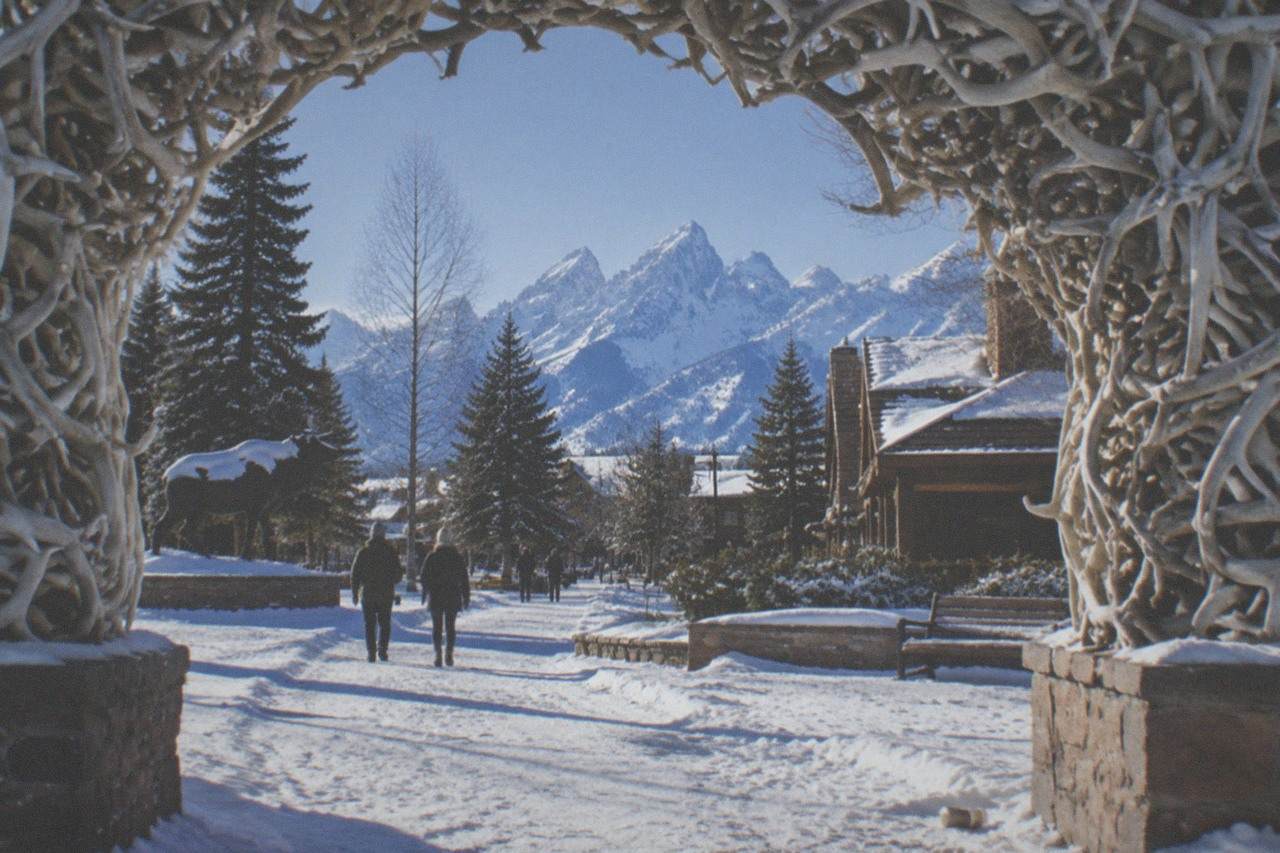
Downtown Jackson's free attractions are the elk antler arches on Town Square and the Town Square holiday lighting celebration. The four corner arches, built from elk antlers, can be walked under at any hour, and the seasonal lighting event turns the square into an evening destination at no cost. Between them, the square anchors a free evening better than most mountain towns manage.
The antler arches are the town's signature. Each of the four corners of George Washington Memorial Park, the square everyone just calls Town Square, carries an arch assembled from thousands of shed elk antlers collected from the refuge next door. They are a piece of local material culture, an accidental monument to the elk herd up the road, and they photograph well in every light the valley produces, low winter sun, blue dusk, or falling snow. Walking all four takes ten unhurried minutes and costs nothing but the cold on your hands.
The holiday lighting celebration adds the calendar draw. Each winter the square lights up for the season, and the event around the switch-on draws locals and visitors into the same few blocks of wooden storefronts. The lights themselves stay up through the holiday period, so a visitor arriving after the opening night still gets the full effect. An evening loop, the arches under lights, the boardwalk porches, a thermos in hand, is a genuinely good free hour in a valley where most evening entertainment carries a ticket.
There is a practical thread tying the downtown section to the wildlife one: Jackson is small. The Town Square is minutes from the Refuge Road pullouts, and the visitor center sits on the same north edge of town. A free day can move from elk at first light, to the visitor center as the morning warms, to the square for the afternoon and the lights at dusk, all without a parking shuffle or a second base. Lodging in Jackson during the winter season runs cheaper than the slope-side villages up the valley, which quietly reinforces the town's role as the sensible hub for mixed-budget trips.
For readers planning wider days, the region offers more free-angle ideas than this page can hold; our piece on winter activities beyond snowmobiling covers the inside-the-park side, and the Jackson Hole versus West Yellowstone comparison weighs the two main hub towns against each other.
Where Can You Ski Or Snowshoe For Free Near Jackson?
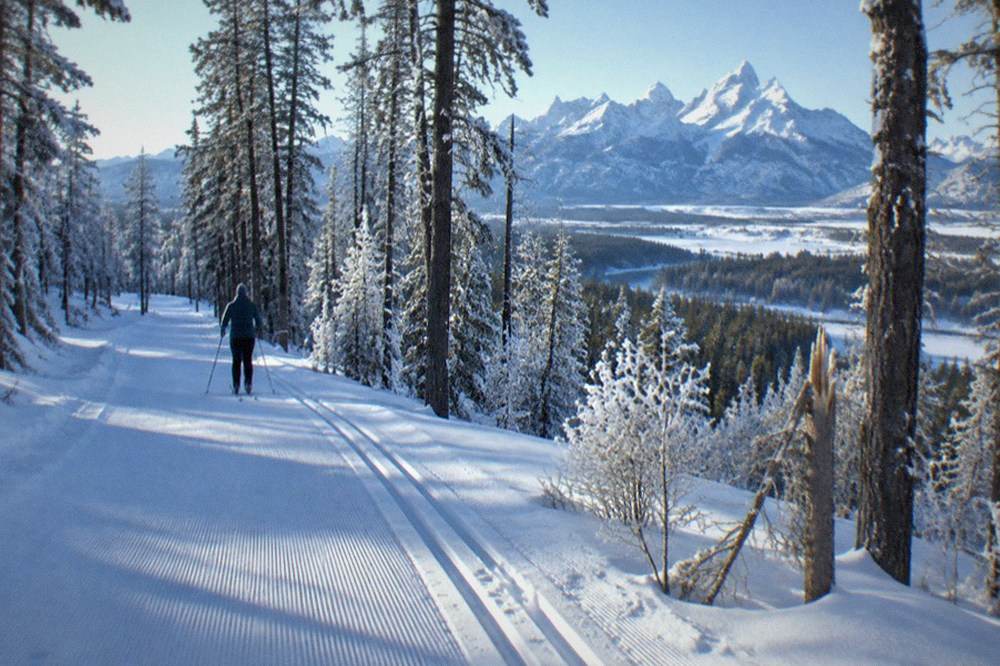
The free Nordic options are the Cache Creek and Gray Meadow trail systems, which are open to skiing and snowshoeing at no charge. Both sit in the hills immediately around Jackson, groomed or tracked by local efforts rather than a resort, and neither requires a pass, a ticket, or a reservation. They are the closest thing the valley has to a free lift-served experience, minus the lift.
Cache Creek sits at the end of the road of the same name, a few minutes from downtown Jackson, and its network of trails doubles in winter as a Nordic and snowshoe system. Gray Meadow extends that world further into the same drainage. Locals treat the area as their everyday training ground, which tells you the skiing is real, not a novelty loop, and the trailheads are close enough that a visitor staying in town can be on snow within twenty minutes of leaving a hotel lobby. Snow conditions vary through the season, so a quick check of the local trail report before heading up is the sensible move.
Two practical notes make these trails work for visitors. First, equipment is the only real cost, and it is avoidable: snowshoeing needs nothing but warm boots with a rental pair, and cross-country gear rents cheaply in town, though renting is a paid step, so call it near-free rather than free. Second, winter safety rules apply to any exertion in this valley. NPS winter guidance for the region stresses layering with windproof shells, avoiding cotton, and carrying sunglasses and sunscreen for the snow glare, advice that holds just as much on a town trailhead as inside the park. Daylight is short in December and January, so an early start is worth more than any piece of gear.
For skiers who want the motorized version of the same valley, there is a paid bridge nearby. The Heart Six snowmobiling tour in Jackson Hole runs in the same Bridger-Teton country east of the park, from $360 per person, rated 4.8 across 50 reviews, over roughly four hours from the meeting point at Buffalo Valley Road in Moran. It is not a Yellowstone tour and does not enter the park; it is the valley's own snow-country, ridden on a sled.
How Do The Free Jackson Activities Connect To Yellowstone Itself?
They connect through one operator decision: the commercially guided tours that reach Yellowstone's winter interior depart from Jackson itself, with hotel pickup in the Jackson area, and enter via the South Entrance. So the free itinerary and the paid park day share the same base town. Nothing free reaches Old Faithful in winter; a guided snowmobile or snowcoach tour is the only commercially bookable route there.
This is the structural fact of a Jackson Hole winter trip, and it is worth spelling out because first-time visitors often miss it. From mid-December to mid-March, Yellowstone's interior roads are closed to private automobiles and open only to oversnow travel, guided snowmobiles, snowcoaches, and a small number of lottery-permit non-commercial groups. The projected oversnow window for the coming season runs from December 15, 2026 to March 15, 2027, with some interior segments closing on staggered earlier dates in March. A private car cannot drive to Old Faithful during those months, full stop, and the free activities in Jackson, however good, never cross the park boundary.
The bridge is the Scenic Safaris Old Faithful full-day snowmobile tour, rated 4.6 across 338 reviews, from $475 per person, roughly 10 to 12 hours door to door with hotel pickup in the Jackson area. Riders travel by van to the South Entrance, get outfitted with suits and helmets, and ride the groomed road system past stops such as West Thumb and the Fountain Paint Pots before time at Old Faithful itself, then return to Jackson by early evening. The listing describes no prior snowmobile experience as necessary. Its sibling snowcoach tour, from $450 per person and rated 4.8 across 227 reviews, covers similar country in a heated vehicle for travelers who would rather not ride. Note that availability for winter-only products like these can shift between seasons, so checking the current listing before committing dates is wise.
There is a budget logic here that the free-activities page makes possible. A traveler can hold lodging costs down by staying in Jackson rather than a resort village, fill three days with the no-cost lineup described above, and then spend once, deliberately, on the single day that genuinely requires spending: a guided snowmobile tour into the park. This is exactly the mixed-budget itinerary Yellowstone Snowmobile Tours was built to help readers assemble, pairing the free valley days with one well-chosen guided ride into the interior. The one unavoidable extra is the park entrance fee, $35 for a seven-day private vehicle pass, or $30 per snowmobile sled, published on the official Yellowstone fees page. Readers comparing the full cost picture, tour price against fee against lodging, will find the numbers worked through in our guide to what a Yellowstone snowmobile tour costs.
When Should You Plan A Free Winter Day In Jackson Hole?
Plan around the oversnow season, mid-December through mid-March, when the elk are on the refuge, the trails hold snow, and the holiday lights are up. December pairs the lighting celebration with the herd's arrival but brings the shortest days, while February and early March offer longer daylight and typically more settled snow. Any visit in that window should check the road and trail status the morning of, since conditions move fast in this valley.
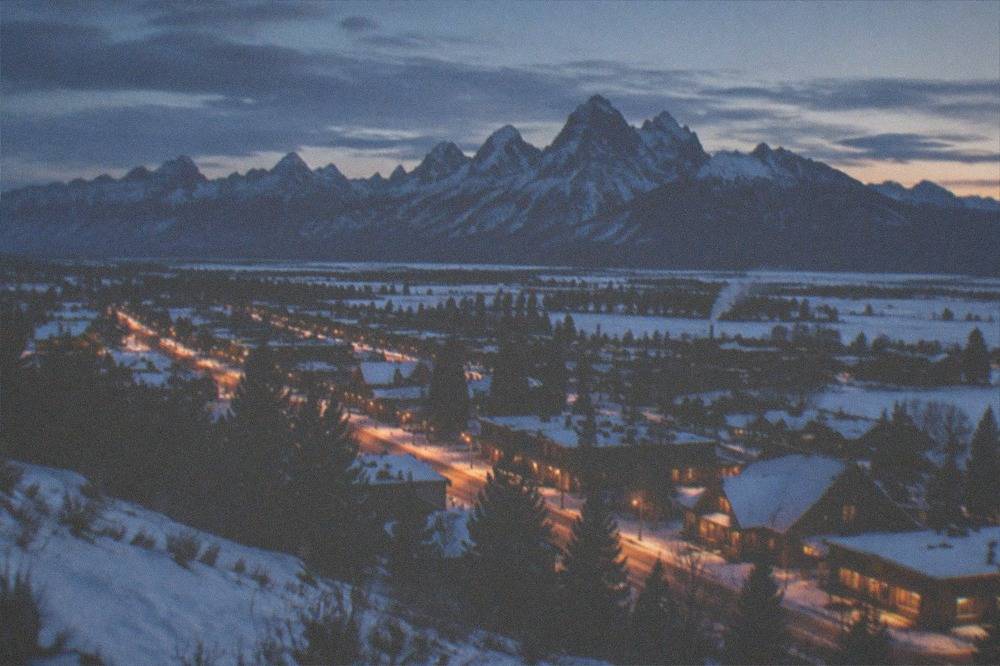
Timing the free activities against the paid ones is mostly a question of daylight and temperature. Winter daytime temperatures in the Yellowstone region run from 0 to 20 degrees Fahrenheit, with sub-zero readings common at night and higher elevations, and wind chill on any open stretch of the Refuge Road can push the felt temperature well below that. The pullouts and the antler arches tolerate cold easily, being short stops, while the Nordic trails and any tour day reward the warmest hours, late morning through mid afternoon. The park's oversnow travel hours run 7 a.m. to 9 p.m., with the South Entrance opening at 8 a.m., so a tour day starts early by necessity.
One planning nuance separates the town from the park. The free activities in Jackson depend on local conditions only, snow in the valley, lights on the square, elk on the refuge, and none of them cancel wholesale because of a storm. A tour day inside Yellowstone, by contrast, lives and dies with the road and weather status, and Sylvan Pass on the East Entrance side can close for hours or days on avalanche danger. Building the free days first and the tour day second, with a flexible morning, is the resilient order.
Readers who want the deeper season reasoning can work through the site's month-by-month snowmobiling season guide, and those weighing a longer stay should think in terms of three to four days for the region as a whole, with the tour day in the middle so weather can push it a day either way.
Common Questions About Free Winter Activities In Jackson Hole
What Are Some Free Things to Do in Jackson Hole in Winter?
The free lineup is the National Elk Refuge Road wildlife-viewing pullouts, the elk antler arches on Jackson's Town Square, the National Elk Refuge and Greater Yellowstone Visitor Center, the Cache Creek and Gray Meadow Nordic ski and snowshoe trails, and the Town Square holiday lighting celebration. None charge admission or a tour fee.
Can You See Elk in Jackson Hole Without Paying?
Yes. The National Elk Refuge sits at the north edge of the town of Jackson, and pullouts along the Refuge Road offer free roadside viewing of the wintering herd. Watch from a distance, stay near your vehicle, and bring binoculars for the animals farther out on the snow.
Are the Cache Creek and Gray Meadow Trails Really Free?
Yes, the trails themselves carry no fee, pass, or reservation. The only likely cost is equipment, since cross-country skis or snowshoes rent in town if you do not own them. Check the local trail report and go early, since winter daylight is short and conditions change.
Can You Get From Free Jackson Activities Into Yellowstone Park?
Not for free. From mid-December to mid-March the park's interior is closed to private cars and open only to oversnow travel. A commercially guided snowmobile tour or snowcoach from Jackson, such as the Old Faithful full-day trips with hotel pickup in the Jackson area, is the bookable route in through the South Entrance.
What Should You Wear for the Free Outdoor Activities?
Dress for temperatures between 0 and 20 degrees Fahrenheit, colder with wind chill. Regional winter guidance recommends a windproof outer layer over wool or synthetic insulation, no cotton, insulated boots and gloves, a balaclava or neck gaiter, sunglasses, and sunscreen for snow glare.
Is Jackson Hole a Good Base for a Budget Winter Trip?
Reasonably, yes. The town of Jackson sits closer to the free activities than the slope-side villages do, winter lodging there tends to cost less than resort bases, and the guided tours into Yellowstone depart from Jackson itself. Costs concentrate in the single paid tour day and gear rental rather than daily activity fees.